
The Hidden Subconscious Patterns That Keep People Stuck
Have you ever promised yourself that this time would be different, only to find yourself repeating the same pattern again?
You decide you are finally going to speak up, but when the moment comes, your body tightens and you stay quiet. You tell yourself you are ready to move forward, yet you suddenly feel overwhelmed, distracted, or unsure. You know a relationship, habit, belief, or way of being no longer supports you, but something inside keeps pulling you back toward what is familiar.
When this happens, many people immediately assume they are lazy, undisciplined, unmotivated, or self-sabotaging. But often, the patterns that keep us stuck are not signs of failure. They are signs of unconscious protection.
The subconscious mind is deeply shaped by repetition, emotion, memory, and survival. It often prefers what is familiar over what is freeing, especially if the familiar once helped you avoid pain, rejection, conflict, disappointment, or shame. This means that the very patterns you judge yourself for may have once been strategies that helped you feel safer.
Being stuck is not always about lacking desire. Sometimes it is about an old part of you trying to protect you from an old wound.
What Are Subconscious Patterns?
Subconscious patterns are automatic ways of thinking, feeling, and behaving that operate beneath the surface of conscious awareness. They influence how you interpret situations, how you respond to discomfort, what you believe is possible for you, and what choices feel safe or unsafe.
In cognitive behavioral therapy, the term automatic thoughts is often used to describe the quick interpretations that arise throughout the day. These thoughts can happen so rapidly that you may notice the emotional reaction before you ever notice the thought that triggered it.[^1]
For example, you may feel anxious before sending a message, but the hidden thought might be, “They will reject me.” You may feel guilty when setting a boundary, but the hidden thought might be, “I am hurting someone by having needs.” You may procrastinate on an opportunity, but the hidden thought might be, “If I try and fail, it will prove I am not enough.”
The thought may not appear as a full sentence. It may show up as tension in the chest, a knot in the stomach, sudden fatigue, irritability, overthinking, or the urge to withdraw. Over time, if the pattern repeats often enough, it stops feeling like a thought or a habit. It starts feeling like who you are.
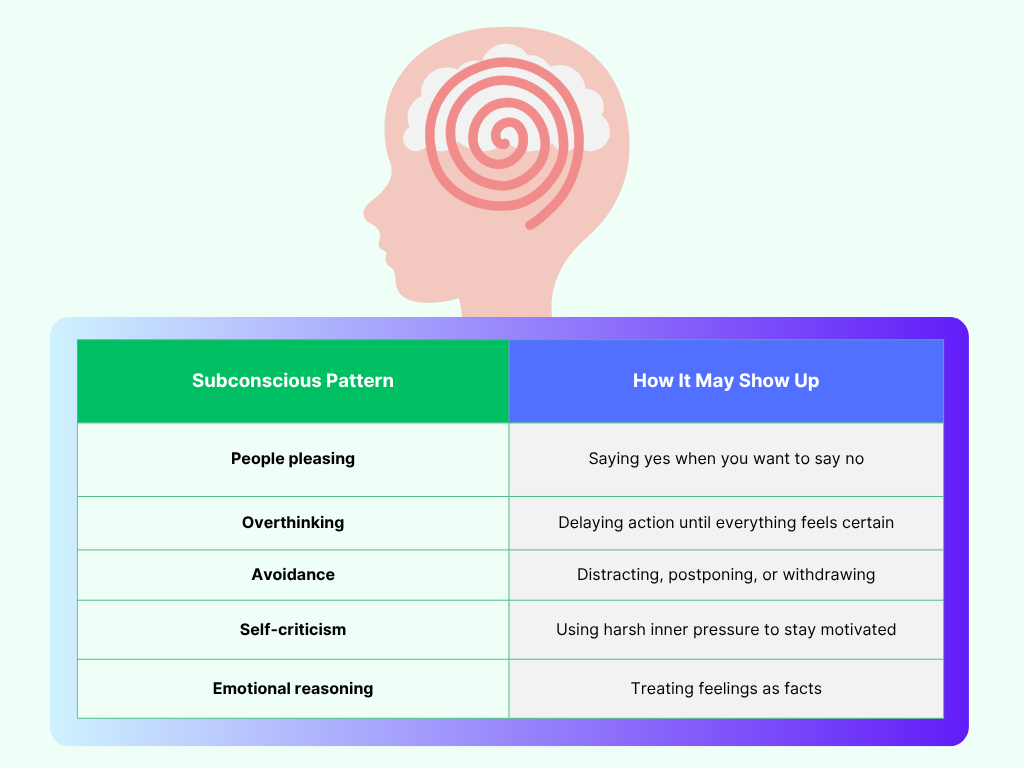
Pattern One: The Inner Script You Mistake for Truth
One of the most common hidden patterns is the inner script. This is the story your mind automatically tells about who you are, what is possible, and what other people’s behavior means.
If someone does not respond quickly, the script may say, “I am being ignored.” If you make a mistake, it may say, “I always mess things up.” If you receive praise, it may say, “They are just being nice.” If you want something more for your life, it may say, “Who do you think you are?”
These inner scripts are often built from old experiences. A person who was criticized may develop a script of “I have to be perfect to be accepted.” A person who felt emotionally dismissed may develop a script of “My needs are too much.” A person who experienced instability may develop a script of “I cannot relax unless I know what is coming next.”
There are several common negative thought patterns, including all-or-nothing thinking, catastrophizing, emotional reasoning, disqualifying the positive, and overgeneralization. These patterns can quietly shape how we interpret our lives.
The problem is not that you have thoughts. The problem is when every thought is treated as truth.
A powerful first step is to practice saying, “I am having the thought that…” For example, instead of saying, “I am not good enough,” you might say, “I am having the thought that I am not good enough.” This small shift creates space. It reminds you that a thought is not a fact; it is an interpretation.
Pattern Two: Emotional Reasoning
Emotional reasoning happens when you believe something is true because it feels true.
You feel anxious, so you assume something is wrong. You feel guilty, so you assume you did something bad. You feel behind, so you assume you are failing. You feel unworthy, so you assume you are not ready.
Feelings are important messengers, but they are not always accurate narrators. Sometimes a feeling is responding to the present moment. Other times, it is responding to an old memory, a familiar fear, or a protective association from the past.
This is especially important when you are trying to grow. New choices often feel uncomfortable at first, not because they are wrong, but because they are unfamiliar. Setting a boundary may feel selfish if you learned that love means self-abandonment. Being visible may feel unsafe if you learned that attention leads to criticism. Receiving support may feel uncomfortable if you learned to survive by doing everything alone.
Discomfort does not always mean danger. Sometimes discomfort simply means you are stepping outside an old identity.
Pattern Three: Avoidance Disguised as Safety
Avoidance is one of the most powerful ways people stay stuck. It can look like procrastination, distraction, emotional withdrawal, perfectionism, indecision, or waiting for the “right time.”
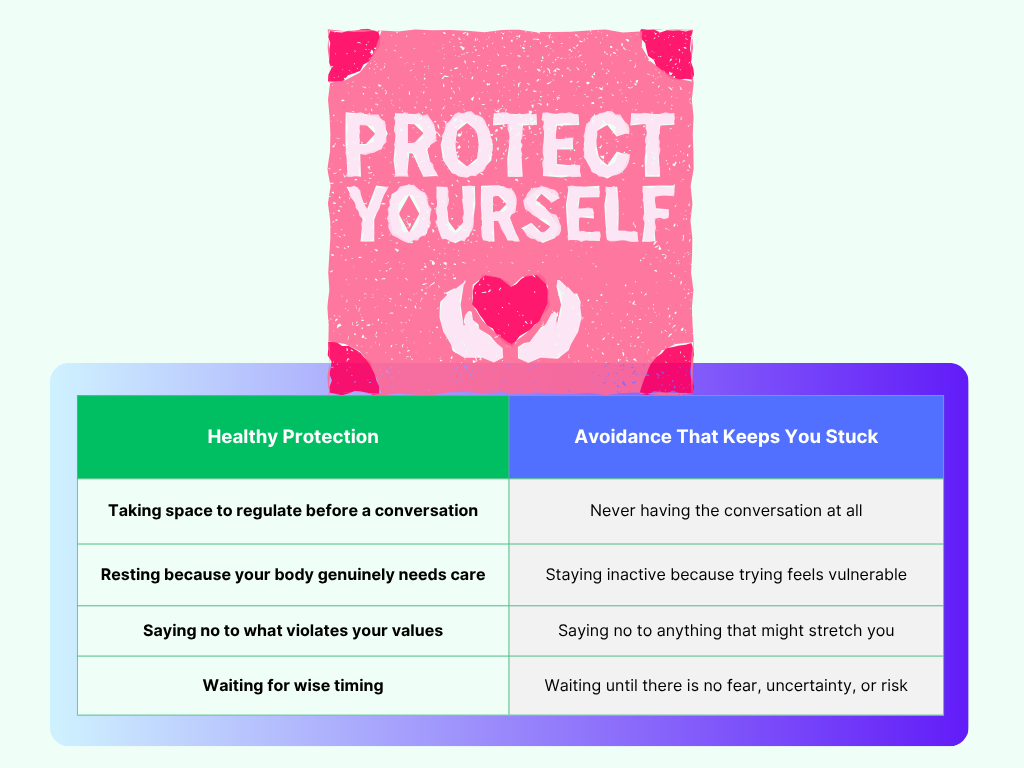
Avoidance is understandable because it often brings immediate relief. If you avoid the hard conversation, you do not have to feel the fear of conflict. If you postpone the project, you do not have to face the possibility of criticism. If you stay busy, you do not have to feel grief, loneliness, or uncertainty.
But avoidance has a hidden cost. Avoidance and escape can maintain distress because they prevent people from gathering new evidence, reduce access to positive experiences, and can gradually shrink a person’s world.
In other words, avoidance often says, “I am keeping you safe,” while quietly reinforcing the belief that you cannot handle what you are avoiding.
This does not mean all avoidance is bad. There are times when stepping away is healthy, wise, and necessary. Rest can be healing. Boundaries can be protective. Leaving an unsafe situation can be essential. The key question is not simply, “Am I avoiding?” The deeper question is, “Is this choice expanding my life or shrinking it?”
Pattern Four: The Familiar Identity
Sometimes the pattern keeping you stuck is not just what you do. It is who you believe you are.
You may say, “I am just not confident.” “I am bad at relationships.” “I never follow through.” “I am always the strong one.” “I am too sensitive.” “I am not the kind of person who can do that.”
These identity statements can feel true because they are familiar. But familiarity is not the same as destiny.
An identity often forms around repeated experiences. If you were praised for being easygoing, you may have learned to suppress your preferences. If you were valued for being responsible, you may have learned to overfunction. If you were mocked for being emotional, you may have learned to hide your sensitivity. If you were repeatedly disappointed, you may have learned to expect less.
The familiar identity can become a cage, even when it began as protection.
Growth often requires allowing yourself to become someone your younger self did not know was safe to be. Someone who can say no. Someone who can receive. Someone who can be seen. Someone who can rest. Someone who can want more without apologizing.
Pattern Five: Habit Loops That Run on Autopilot
Subconscious patterns are not only emotional; they are also behavioral. Many of the things we do are connected to cues in our environment or inner state.
Habit formation can show up through a loop of cue, craving, response, and reward. While this is often discussed in relation to habits like exercise, phone use, or productivity, it also applies to emotional patterns.
A particular person texts you, and your body immediately prepares to please. A deadline approaches, and you suddenly reach for distraction. You feel lonely, and you scroll. You feel judged, and you explain yourself. You feel uncertain, and you seek reassurance.
These responses are not random. They are loops.
The cue may be an emotion, a time of day, a location, a certain type of interaction, or even a familiar tone in someone’s voice. The reward may be temporary relief, approval, control, numbness, or the avoidance of discomfort.
Once you understand the loop, you can begin to interrupt it.
How to Begin Breaking the Pattern
Changing subconscious patterns does not begin with force. It begins with awareness. You cannot shift what you keep shaming, denying, or rushing past.
The next time you notice yourself repeating an old response, pause and ask yourself a more compassionate question: What is this pattern trying to protect me from feeling?
This question moves you out of self-attack and into self-understanding. It helps you see the pattern not as your enemy, but as an outdated strategy. And once you can see it as a strategy, you can begin to choose a new one.
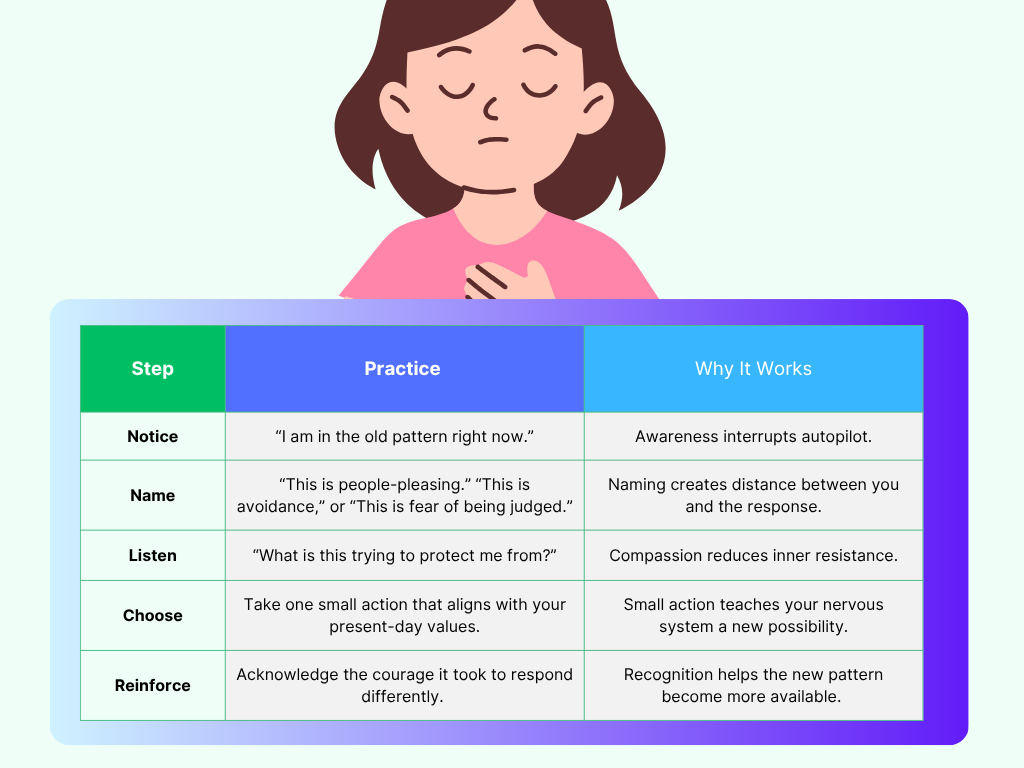
A small opposite action might be sending the message instead of rewriting it ten times. It might be beginning the task for five minutes instead of waiting to feel ready. It might be stating your preference instead of saying, “Whatever you want.” It might be accepting a compliment without minimizing it. It might be resting without earning it first.
These changes may seem small, but they matter. Each one sends a new message to your nervous system: I can be safe and choose differently.
The Goal Is Not to Fight Yourself
Many people try to change by attacking the part of themselves that is afraid. They criticize the procrastinator, shame the people-pleaser, pressure the overthinker, and resent the part that keeps returning to old patterns.
But the parts of you that are afraid usually do not need more judgment. They need updated evidence.
They need to learn that conflict does not always mean abandonment. Visibility does not always mean danger. Rest does not mean failure. Boundaries do not mean rejection. Receiving support does not mean weakness. Wanting more does not mean being ungrateful.
Freedom does not usually arrive as one dramatic breakthrough. More often, it begins in a quiet moment of noticing. You notice the thought before believing it. You notice the urge before obeying it. You notice the old identity before shrinking back into it.
And in that moment, you create a choice.
You do not have to become someone entirely new. You can begin by recognizing who you had to become to survive, honoring the protection that once helped you, and gently choosing what is more aligned with who you are becoming now.
Final Reflection
If you feel stuck, it may not be because you are broken. It may be because an old pattern is still trying to keep you safe in the only way it knows how.
The invitation is not to shame that pattern. The invitation is to bring it into the light.
When you can see the pattern clearly, you can meet it with compassion. When you meet it with compassion, you can begin to update it. And when you update it one small choice at a time, your life begins to expand beyond what once felt familiar.
That is where change begins.


